
G7 Draws to a Close, and It's All Complete Nonsense
The Tokyo G7 conference a few days ago regarding the global economy was, I think, complete nonsense.
In the first place, without China or Russia participating, it just doesn't have the clout it used to. The functionality of the G7 structure itself is impaired.
If the G7 is the 'place to discuss real intentions', their talk should be more pragmatic. For instance, "The reason the country called 'America' is collapsing is because the should have saved and exported more", or "A substitute for oil should be quickly liberalized."
Also, "The American dollar's function as the reserve currency is dying", is something I'd also like them to accept. A unified world currency is necessary. However, how that currency is made is important, as is ensuring that it's distribution is open and transparent. The currency system we have now, through which powerful people manage the world in secrecy, is a cancer upon the Earth.
Sunday, February 10, 2008
Benjamin Fulford, 11 Feb 2008

Saturday, February 9, 2008
Benjamin Fulford, 09 Feb 2008
What the Hell Are the Americans Scheming, Cutting Those Undersea Cables?
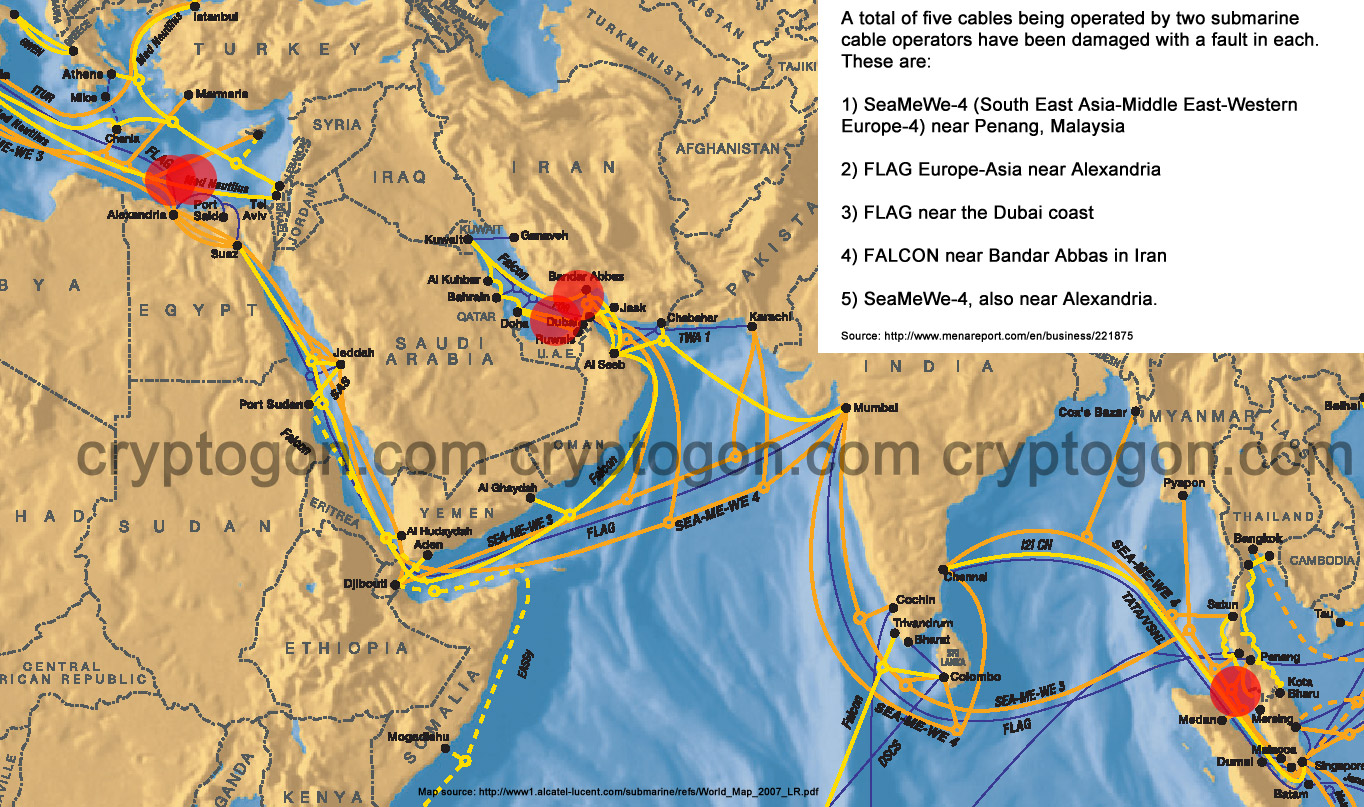
The news is saying that nine undersea internet cables [ed: link added by me, not part of the original post] have been cut in the area of Asia and the Near and Middle East.
The official explanation is that a ship's anchor is the source of the problem, but with nine cables in separate places being cut almost simultaneously, it's strange now matter how you think of it.
I've got to say this looks like the American's are scheming to do something, don't you think? Iran is going to be opening up an oil bourse selling in non-US dollars pretty soon, which Saudi Arabia might use too, and maybe there's a relationship with this.
With the American dollar losing it's status as the world's pivotal currency, a cornered America is playing a childish prank. This is the kind of thing countries occupied by the criminal American organization understand all too well.
The Damaged Cables
Cryptogon generously provides us with this map of the five damaged cables.
Yep, definitely done by an anchor. No question.
Oh, and apropos of nothing, I've got some farmland on Baffin Island for you, if you're interested.
Snowing in Tokyo
It is now snowing for the 4th time in the last two weeks, and man is it ever coming down. This is not normal weather for Tokyo, not at this time of year.
The next time someone mentions 'global warming' to me, I may punch them.
Friday, February 8, 2008
Gloating
As someone who smokes more than is good for him - and enjoys the filthy habit more or less unapologetically - please permit me a moment of malicious retributive glee.
Restaurants in Mississippi may start banning fat people.
After enduring the smoking ban, that forced me out into the cold in order to have a smoke - a ban enforced by overzealous health fascists who even banned tarp-covered, gas-lamp-heated patios as being 'indoor' areas (de facto smoking areas that anyone from Toronto will dimly recall sprouting like mushrooms in the winter following the smoking ban, only to be culled by control freak health inspectors enraged that the spirit of the law was being skillfully evaded) - along with the po-faced hand-waving of non-smokers whenever they had the misfortune to walk by me on the street ... well, let me just say this:
I have for some time been of the opinion that if you don't want to pay for my emphysema? Hell, that's cool. I don't want to pay for your adult-onset diabetes. Moreover, if my smoke offends your sensitive nostrils, well, lard-bottom, your cellulite offends my delicate eyes, and there's no inherent reason why your aesthetics should prevail over mine. And as we're seeing, the health nazis seem to agree.
Not so great now that they're are after you, now is it? Worse, really. All I have to endure is an hour or so of mild discomfort and accompanying irritability, between parking my ass at the table and stepping out for a smoke. You won't even be allowed to eat in public. Enjoy your smoke-free TV dinners, butterball; I know I'll enjoy not having to look at your fat ass (I could not look, true, but let's face it: not looking is as hard as pulling one's eyes away from a train wreck.)
Oh, I know shouldn't gloat. What's being done to you fatasses is no more ethical than what's been done to us smokers. In truth, I'd much rather we could live and let live, but in the meantime, I really just can't help but laugh at your ass. Because you know what's more embarrassing than lighting up and being told that it's a no-smoking zone? Walking into the Denny's with your wife and kids, and having the manager step forward with an apologetic look on his face and a tape measure in his hand.
Benjamin Fulford, 07 Feb 2008
Akiro Ootani's Goodbye Party
At the end of last year the famous media producer Akiro Ootani died; recently, I attended his goodbye party.
He was responsible for many famous TV shows, and after retirement he made various plays about the Meiji Restoration in order to encourage politicians. The actors concentrated on members of the Liberal Democratic Party, and every time I was given a role, too.
Right up until the last moment he used every bit of his life force and his money for the sake of all.
They're saying the cause of death was suicide, but numerous riddles remain.
People like him, who devote themselves to their fellow man, are, I think, treasures of all mankind.
Wednesday, February 6, 2008
British Army Training the Taliban
Good god. The British were planning to build a training camp for the Taliban. You'll have to scroll down a bit ... for some silly reason the top of the page is crowded with links.
Sphere: Related ContentAnd Then There Were Five....
I won't add to the growing storm of speculation over what, exactly, is going on with those undersea cables, or why they're being cut. I'll just say this: five cables makes it pretty goddamn obvious that this is intentional.
Sphere: Related ContentSmoking Mirrors
I usually link to individual posts, but ever once in a while I find someone so outstanding that I just have to say, go read everything you can. This guy (or gal, but the authorial voice is very male) writes like an righteously enraged Kung Fu master of the English language, a blind swordsman who's drifted into a corrupt town, had a look around, and is now taking names and kicking ass out of pure disgust with the gangsters who control the weak, frightened, and pathetic creatures that scurry out of the way every time the capo and his goons go on their rounds.
I present to you Les Visibles, the nom de guerre of the mind behind Smoking Mirrors.
Now git over there. Nothing I write here can be half so interesting.
Tuesday, February 5, 2008
Benjamin Fulford, 05 Feb 2008
Is America Going to Attack Japan with an Earthquake Weapon?
According to information from the Inagawa Gang's leadership [ed: that's a massive gang operating in Tokyo, with a membership of 5100. Link to Wikipedia page.], America is threatening to hit Kanagawa with an earthquake around the end of the month. After that, in March or April, it seems they're saying the attack will escalate to hit Chiba and other areas around Tokyo.
In the event that this is carried out, although I've urged restraint up until now, I'll call upon the Asian secret society to execute their plan to assassinate members of the Illuminati.
Somehow, for the sake of everyone on Earth, the murderer's in the American military must be stopped as soon as possible.
Earthquake weapons might sound a little crazy, but there have been rumors of something called a scalar weapon, originally developed by Nikola Tesla, which can trigger seismic activity. A search turns up lots of interesting links.
Fractal Africa
Wow. I really should keep up with those TEDtalks videos.
This one is just fascinating: Ron Eglash, an 'ethno-mathematician', spent a year traveling Africa, where he discovered that almost every African village is constructed, quite consciously, according to precise fractal algorithms, repeating all the way from the village as a whole down to the arrangement of pots in a room. And it's not just their villages: their art and even their divination practices use fractal patterning.
I remember when I was in uni, I was arguing with one of the foreign development kids, and insisting that Africa (well, sub-Saharan Africa) never had a 'civilization', exactly. I was really just trying to push her buttons, but man, what a thick-skulled idiot I can be.
The Funky Guerrilla War Being Fought By Paris' Army of Hard Truth Soldiers
Anyone who knows anything about me knows I've never been much into hiphop. Oh, it's not that I dislike it - maturity has brought me a long way from my teenage hatred of anything that wasn't played on electric guitars - it's just that I never really got into it. White boys listening to hiphop always struck me as kind of silly, especially when they got right into it and started dressing up like gangstas and tryin' to front like they was from the hood, know wha' I'm sayin'? Metal, punk, trance, drum 'n' bass ... things like that have always been more to my taste. The closest I ever got to rap was Rage Against the Machine.
I could respect hiphop though, at least the older stuff, Public Enemy and Tupac and Biggy; the world play is right up there with Tennyson and Walt Whitman, and you could tell, when you listened to it, that it was real, music that came straight from the heart. The more modern stuff, the kind that came to dominate over the past ten years or so, is an emaciated shadow of what was being made in the 90s, real artists replaced by interchangeable pod people rapping hollowly about getting high, getting rich and fucking ... soulless muzak, corrupted by money and subverted to serve corporate interests. I could see that even without being much of a fan of the form; the same thing happened to every genre since the first vinyl record was printed, in a cycle that's grown as familiar and predictable as the passage of the seasons: raw and fresh from the streets and the clubs, a bloom in popularity, maturity, and a dwindling into artistic irrelevance as the profit motive sucks out the soul of the movement and leaves nothing but the empty shell of appearance and recycled melodies.
Well, that could be changing that's changed. A few days ago I was listening to the Alex Jones show and he played What Would You Do by Paris, of Guerilla Funk. Now this guy is hardly a newcomer - he's been making records since '91 - but if guessing you've probably never heard of him. It's not because he's untalented; it's because he refused to sell his soul to a label, trading truth for money. As you might guess from his presence on the Alex Jones show, this guy understands the New World Order, and for well over a decade now he's been using his talent to fight it the only way it can be fought, by bringing truth to the people.
9/11 reinvigorated him and has him, in his own words, "Spittin' cyanide from each and every verse." And not just him; he's got a whole crew now, on his Guerilla Funk label, mostly new faces (well, so far as I can tell), but counting in their ranks Public Enemy. More soldiers in the information insurgency, a movement that's burgeoning now, beginning to take on the look of something truly historical, truly momentous. Musicians, artists, writers, bloggers, academics, political activists, youtubers ... the rョVOLution is boiling up from every node of the world's wide Web, and it cannot be stopped any more than a volcano can be plugged or an earthquake stilled.
So do yourself a favor. Go to the Pirate Bay and download yourself the Guerilla Funk collection. If you like it, buy the CD. Even if you don't, give it a listen. It's some inspiring shit.
Monday, February 4, 2008
Mass March in Bogota
 This is a mass march in Bogota, organized using facebook and other social networking tools.
I have no idea why specifically they were marching, but this is the kind of thing that brings a nasty smile to my face.
The internet hates tyranny. I hope this picture gives the pathocracy nightmares.
Benjamin Fulford, 04 Feb 2008
You've probably never heard of this guy, right? Here's the Cole's Notes: dude's been living in Japan since the early 80s, long enough that he speaks the language like a native. For the last half of the 90s he capitalized that by becoming the national bureau chief for Forbes magazine, a position he left when he was told he couldn't publish a story connecting government corruption to the yakuza. He continued pursuing the story on his own, eventually getting enough material for a book, and then - just before he could publish it - was clued in to what was really going on by a member of the Japanese Imperial family. The story expands in scope when, in the aftermath of confronting the former Japanese finance minister over his selling out of the Japanese banking system to the Rockefellers, he's contacted by someone who claims to be a ninja (!!!) and offered either a) a position in the New World Order or b) death. Right on the heels of that, he's contacted by a representative of a Chinese secret society that dates back to the Mongol invasion, who offers him their protection if he agrees to act as their go-between, ambassador as it were between the amusingly misnamed New World Order of the West and the Newer World Order of the East. This secret society, a sort of more-ethical Eastern counterpart to the Illuminati, had a fire lit under their pants after SARS, which they interpreted as either a test run, or a failed deployment of, an ethnic-specific bioweapon. Okay, so it's a pretty incredible story, yeah. But you know, the guy got an interview with David Rockefeller not too long ago, and he doesn't hand those out like candy. If you're interested in the rest of the story, everything else you want to know (or, well, can know) is archived here. All of this serves as a preview to a project I'm going to try and hold myself to for, well, as long as I can: English translations of Fulford's blog posts (which are in Japanese). I do this with no permission, so I hope he doesn't mind (and if I translate anything wrong, well, please, correct me in the comments. I'm not proud). Anyhow, here goes nothing:
About Those Chinese Gyoza
Those Chinese gyoza are probably the CIA's underhanded dealings.
One thing the West fears above all else is Japan and China becoming good buddies. In this case the use of agricultural chemicals at the Chinese gyoza factory can't be confirmed. It's clear that in order to worsen Sino-Japanese relations, there was some dirty business involving overseas authorities.
Now, of course there are some questions of hygiene management on the Chinese side, but the way this is being covered on TV is overt propaganda. In practice there are all sorts of pretty serious problems with American agricultural products too - agricultural chemicals, BSE, etc - but the coverage in the mass media is completely different.
Also, there's been information that there's been an extremely high number of chemtrails in Southern Japan, and this is probably related to weather modifications aimed at China that have been partly responsible for the heavy snowfall there. That's a just a guess, but I can't help but make it.
The American and European secret societies are getting desperate to obstruct Asia's rise, set to begin on the 8th of August.
On the Governer of Tougoku
He's definitely an individualistic guy, and it looks like he's got a variety of things in his past, but he's not your normal politician who's been brainwashed by his educational background. He thinks things through using common sense. Hence he seems to lack common sense, by the standards of the current organization.
Present day Japan is divided into Tokyo and everywhere else. It angers the rest of the country when Tokyo is given too much attention. Giving some thought to the rest of the country, the economic foundations of Japan should be fundamentally changed.
I've met a lot of politicians in the course of my data gathering, and this guy feels different.
On the Composite Photograph from the Skies of Okinawa
Thanks for all that information rushing in at once, after I posted on that strange photograph from Okinawa the other day!
The picture was sent to me from a politician, and as soon as I saw it I saw right through it, figuring it was probably a fake, but I decided to get your opinions. What I mean is, I wanted to see the Net's 'photo investigation power' at work. Everyone pooled their resources, and the photo was immediately revealed for the utter bullshit it was. Actually it wasn't from Okinawa or recent, just bullshit. Sorry for the confusion. Nevertheless and meeting my expectations, not one of you took it for the 'Hand of God'.
From now on I will of course be very careful in verifying the source and credibility of any information I receive, but whenever I get anything wrong please correct me immediately. At that time I want to pass along the most accurate information I can, so I'll be using this method.
The picture he's talking about is this one:
I think it looks rather like God giving mankind a goatse.
Life After People
I don't have a TV, and haven't for several months now. To be honest, it's not something I miss: most of what's on is crap, and on the odd occasion when there's something I actually want to watch, well, that's what bittorrent is for, right?
So a couple of days ago I downloaded the History Channel's 'Life After People', and last night, with some time to kill after work, I watched it. It left me with a bad taste in my mouth, the kind you get after you click one of those 'don't click these link' posts that leads to Tub Girl getting shat on by Goatse.
It starts out by magicking six and a half billion people off the planet. What happened to us is not explained; everyone just sort of disappears. Who knows, maybe we all transcended into hyperdimensional demigods, maybe Jesus decided we were all born-agains at heart and raptured us all up to the Kingdom of Heaven, maybe everyone just underwent spontaneous combustion. In the real world, of course, something more mundane would cause our mass disappearance, like cometary bombardment, nuclear armageddon, or the ultimate war plague.
Everything that follows in the History Channel's sick little giga-snuff flick is irredeemably tainted by this sweeping of the mass extinction of mankind under the rug. If the extinction was due to a nuclear spasm, then the every urban environment would be well fried, making the subsequent hour and a half of lovingly detailed exposition on the gradual decay of man-made structures somewhat pointless, as those structures would be, for the most part, gone at the same time we are.
If the species succumbed to biowarfare, the faults aren't quite so egregious, but one part - fairly early on - sticks out, in which the fate of mankind's pets is discussed (again, if it's nuclear war, the pets, like the buildings, are gone along with us.) It's mentioned that the dogs would have to scrounge for food in the city, though what, exactly, it is that they'll be eating is left unsaid. Well, to start with at least, the answer to that is obvious: they'll be eating human cadavers.
Most of the movie, like I said, comes down to an extended meditation on the decay of our buildings, our bridges, our monuments, and our cities, as the elements and the biosphere conspire over centuries to swallow everything every built by humans. The main point seems to be that nothing is permanent, and that should we disappear, every trace of our presence on this planet would be utterly erased in a geological eyeblink even shorter than the one that we called written history (except for Mount Rushmore, which David Brin points out may well last hundreds of thousands of years, carved as it is into solid granite. Then again, hundreds of thousands of years is still pretty short measured against billennia....) You might think that's rather obvious - ashes to ashes, and all that - but the producers didn't seem to think so. Indeed, the documentary seemed to positively exult in the way that nature would reclaim our cities.
One creepy moment near the end really sticks with me. One of the contributors, a cadaverous white-haired geriatric with the bright eyes of a mad scientist, his hands fluttering about like some sort of overstimulated British poof, enthusing about his vision of vines creeping over the Manhattan's skyscrapers as the forest eats the city. After that I had to ask, was this just a documentary? Or was it really extinctionist propaganda?
Hell, don't take my word for it. You've got an internet connection, and too much time on your hands (or you wouldn't be reading this). Watch it yourself.
Saturday, January 5, 2008
Privatopia
About a week ago John Robb at Global Guerillas posted a truly frightening little essay called Privatopia, in which he considers what the US might look like under a fully privatized, corporate regime. Robb's not known for his optimism, and he's true to form here: the vision he presents is one in which the entire US government (along with every government around the world) has been sold off at fire-sale prices to multinational corporate interests, with what's left behind mainly functioning to service the national debt. At one point, he mentions that the privatization is popularly but 'incorrectly' termed "The Great Theft".
He goes on to paint a picture in which most of the country is continuously paralyzed by riots and civil disobedience, controlled by a mixture of surveillance technology and mercenary security forces meting out summary justice to criminals (empowered to do so by automated court systems that give their verdicts in seconds, based on evidence collected from the surveillance network.)
There was a time, not so long ago, when I would've positively lusted for a future like this: grim, dangerous, gritty, straight out of the cyberpunk novels I feasted on as a teenager. Now, older and, if not wiser, at least more jaded, the prospect of the future John Robb sees is just deeply, viscerally terrifying. Give it a read, though, because he shows exactly what the New World Order has in store for all of us.
Thursday, January 3, 2008
Ron Paul's Bright Future As a Martyr
Assassinating Ron Paul would be a really bad idea.
I can see why the elites might find the idea attractive, and - according to Daniel Estulin - are giving it serious consideration. The man wants to dismantle the IRS and the Federal Reserve, the two main pillars of banker control in the US. Loosing those bonds would remove America from New World Order influence as effectively as Ghandi freed India from the British. Beyond that, he'd pull the US back from it's pointless wars in Iraq and Afghanistan, which would effectively defuse the Third World War they'd been planning in order to consolidate their control over the globe. Ron Paul in the Oval Office would be an unmitigated disaster for their interests ... one from which they might never recover, given various trajectories in technology and the economic and social trends that are being driven by those developing technologies.
But you know what? As bad as Ron Paul might be for them, his assassination would be worse. Over the past several months, a networked political movement has grown around Paul as though a seed crystal were dropped in a prepared solution. The network's composed of an incredible diversity of groups, splinter movements and fringe elements and perhaps most strikingly, a generous helping of previously apathetic non-voting independents, people who have nothing in common save a disgust with traditional politics and entrenched policies. What they want isn't Ron Paul, it's to decisively squelch the fascist puppet government being put in place, before it's too late. Ron Paul is only a focal point for this movement because he's the only politician who wants to do this.
So let's say they go ahead and give the green light, and by bullet, bomb, or 'accident' Paul is shuffled off the political stage. Well, the movement would be thrown into chaos immediately after. But that movement is a creature of the internet, a social network that can coalesce around anything, be it a political candidate or an ideological martyr ... and can do so with blinding speed.
Paul is a great man. That someone as apparently morally pure and benevolent can even exist in this sad and twisted age is an astounding thing, one that is hard to believe until one looks, and sees, a man who is as without sin as any saint of old. Men like Paul are as rare as Ghandi. Alive, he would be a competent administrator and a popular reformer, one who would go down in the history books as one of the greatest presidents the American republic has ever enjoyed. Dead, and the social network that's chosen him as an anchoring point might turn him into a figure of religious adoration. The freedom movement would then become a religion, one as toxic to the roots of the global order as Christianity was to the Roman Empire.
Can they look that far ahead? I suspect they can, for I can, and I'm but one man. That killing Paul would turn him into a martyr is surely a possibility that has occurred to them, and with any luck the risk of that happening is enough to stay their hand. But you know? I don't think it will be. I have very little confidence that Paul will ever sit in the Oval Office; as he approaches the goal, as the movement around him swells, so will panic at the top spread. They will only be able to take so much before the pressure grows intolerable, and, not knowing what to do, they have Paul killed.
That might buy them a year or three, but in the long run it will seal their fates more permanently than a Paul presidency ever could.
Tuesday, January 1, 2008
A WikiConstitution
Ah, a long silence there. This time I have a good excuse, though: I was wandering about in Cambodia for a week.
So, I've been thinking more about the idea of applying a wiki spirit to the creation of law. This is unlikely to happen soon, not down at the level of criminal law or anything else directly enforceable. But that doesn't mean the electorate of the planet can't start to get some practice in, and starting right now. What I'm thinking of is an open project to enumerate a sort of meta-constitution, a document that could be used as a model for constitutions all over the planet.
Now, the probability of some form of world government coming about sometime in the next century, and sooner rather than later, is hard to ignore. Multinational corporations, NGOs, and the UN have almost completed their coalescence into a meta-government of which nation-states are reduced to the status of less-than-sovereign duchies. This need not be a bad thing, and indeed is historically inevitable one way or another: once civilization started happening, the tendency was for larger and larger regions synergetic regions (cities, states, kingdoms and empires) to assert themselves. To predict that eventually one would rise to encompass the entire world is a very straightforward extrapolation of the historical record.
Of course, the first form of global government is likely to be a very bad thing indeed. The thing that is currently emerging is fascist, exploitative, wildly unequal and undemocratic, more like the Assyrian Empire than the United States of America that it will be superseding. It will be as disastrous for America as it is for everyone else subjected to it.
But it needn't stay that way. One possibility is that the internal contradictions of the first global empire will cause it to fall; if the fall is not too bad (economic collapse, rather than a nuclear spasm) something new, and hopefully better, might rise to replace it. Another possibility is that the citizens will reformat it themselves, demanding the imposition of true global democracy to accompany global corporations, global armies, and global bureaucracies.
A global democracy - a demosphere - would need a constitution, or at least a meta-constitution, something that would provide a limiting framework for the sorts of constitutions member-states are allowed to form. Something to enumerate the rights - and the duties - of people and organizations everywhere on the planet. And who better to write that meta-constitution than the people who will live under it? Throw open the doors for a year, a decade, or better yet, forever; allow anyone who wants to add or edit any passage they wish, with the officially adopted portion being that which consists of passages receiving the highest percentage of 'yes' votes.
Now, contrast this with the closest existing thing to a global meta-constitution, the UN Declaration of Universal Human Rights. It's filled with a lot of very nice language about freedoms to this and freedom of that, all rather pleasing if dull to read. There is nothing there to immediately excite distress, though buried at the bottom is an item that allows any and all of those human rights to be revoked if they conflicted in any way with the UN ... an unsurprising condition, given that the document was composed by a small group of thinkers acting at the behest of powerful men, entirely without the consultation of the people it was meant (symbolically, at least) to apply to.
Now, just creating such a thing wouldn't, in and of itself, guarantee it's enforcement. Not directly, at least, and not at first. For a very long time - years, perhaps, but more likely decades - it would be nothing but some pages on the web. But the project could grow, perhaps to the point of millions around the world actively collaborating on the project, with billions more aware of it (and free to jump in whenever and wherever they felt.) The mere act of participating would raise consciousness about our rights in responsibilities in a global state, and that would in turn lend the project a moral weight that would eventually make it impossible to ignore, a global constitutionalist movement that one way or another would need to be confronted. Eventually, it could become the central text of an ideology of freedom and rule of law that pervades the world.
Sunday, December 23, 2007
The Right to Keep and Bear Recording Devices
Throughout history, there have been technologies that are so fundamental to power relationships within a society that their possession and use has been an inevitable bone of contention. The most well-known example of that is firearms. Being in many ways the ultimate personal weapon, a great equalizer that nullifies any advantages of physical size or strength, gun rights are argued endlessly. Some feel that the possession of guns by private individuals is too dangerous, as it raises the lethality of interpersonal conflict, and thus argue for gun use to be restricted to the police and the military; others argue that widespread firearms ownership is the best protection against criminal behaviour and state oppression. In some countries, with weak central governments (or none, as in Somalia), everyone is allowed to possess a weapon more or less by default. In contrast, some countries with strong central governments (Japan, England), have banned them outright. The US has a right to keep and bear arms written into it's constitution (though that right has been steadily eroded, as the central government became more powerful.)
This is not a new battle; pre-gunpowder societies saw similar argument and diversity regarding the use and ownership of all manner of weapons. In some places, everyone was allowed to walk about openly armed; in others, the possession of a weapon was strictly limited to professional warrior castes and nobility. And once again, in general, the strength of central government was a good predictor of the degree to which weapons were restricted.
In terms of the effects of personal combat systems on society, firearms have likely come about as far as they ever will. Great improvements in accuracy might well be made (smart rounds, for instance); completely different propulsion systems used which increase muzzle velocity (say, electromagnetically instead of chemically); but the overall principle of a handheld weapon that makes one human more or less equal to another in combat potential, regardless of physical size or strength, is unlikely to change.
Personal recording devices, on the other hand, are just beginning to make their presence really felt. From their first appearance in the 20th century - expensive, delicate, their use restricted more or less to professionals and hobbyists - they have no proliferated to the point where practically everyone has a digital camera, often built into their phone. Technologies such as the eyeFi are allowing pictures to be instantly uploaded to the web, viewable by anyone. We are entering the age of the participatory panopticon, where everyone is watched by everyone.
Some see this as a dangerous attack on liberty, as they believe the constant surveillance will be exploited by states and corporations in order to build a perfect tyranny where everything - and everybody - is watched, tracked, tagged and thus controlled. They are not wrong to fear this; it is almost a certainty that such surveillance systems are being prepared right now. In some parts of the world, tyranny will be a very real possibility ... especially if the citizenry are not in possession of their own recording devices.
The reasoning is simple. If the people are watching, recording, and sharing information as much or more than the government, it becomes very difficult for the government to engage in criminal behaviour (which surely any attempt to tyrannize, anywhere, should rightly be considered.) Just as a citizen breaking a law will be instantly caught, so an official violating someone's human rights will be instantly known. Tyrannies can't survive such openness, relying as they do on the complicit ignorance of their victim populations.
The conflict over use of personal recording devices has already began. If you doubt this, just try walking around and airport taking lots of pictures. I have no doubt that it will intensify greatly, as more and larger areas become designated 'no-photography' zones. 
(You know, sometimes I wonder if an empty no sign might not be the most apt symbol for the corporate fascism that seems to be the prevailing form of governance at the outset of the 21st century. Someone should make an internet map of number of no-X signs per city block. I'll bet you could correlate that to fascism pretty nicely.)
Conversely, areas where freedom prevails will be those in which sousevailling citizens vigilantly watch their masters from below, immediately punishing even the slightest infraction against human rights, and thus maintaining a healthy balance between rule of law and protection of rights and freedoms. Just as America preserved its famous freedom through two hundred years by enshrining the right to keep and bear arms in its constitution, an inalienable right to record and disseminate whatever one pleases will be an invaluable protection in the future. Freedom of speech, yes, but also freedom of sight.
The dichotomy between freedom and tyranny is closely bound to secrecy and transparency, which are respectively anathema to the one and a necessity to the other. If you want to keep freedom alive in the twentieth century, you're going to have to fight for your right to point a camera at the ones who want to take it away.
Monday, December 10, 2007
WikiLaw
I've thought a lot about how democracy can be improved by utilizing the internet, and one of the main ideas that's always guided me is that in a modern, educated society, citizens should vote, not for people, but for ideas. In other words, citizens should decide the law directly, rather than delegating representatives to do it for them ... those representatives, being human (and moreover, that particular type of human who is attracted to power like a moth towards a flame) will inevitably represent their own interests rather than those of their constituents.
So when I saw this article, the light bulb floating above my head starting blinking like mad:
MOB JURISPRUDENCE When the New Zealand police force said they were open to suggestions about how to rewrite national policing laws, they meant it. In September, they posted the 1958 Police Act online and invited Kiwis and non-Kiwis alike to visit the site and type in their own revisions to the law — extending the concept of “Wiki”-style collaborative writing from encyclopedias to democracy.
This is a brilliant idea, and I'm convinced it could be taken much further than simply culling an advisory document, as the Kiwis used it. A wiki is the ultimate democratic forum: not only can you say whatever you want, you can edit what other people say, expunging their contributions entirely. Now, this is very similar to how bills are created inside legislatures: elected representatives and their staffs add and remove clauses and subclauses until a workable compromise is found, at which point it's put to a vote. The wiki platform could allow this process to be expanded to include the entirety of the citizenry, and in so doing, lead to much better laws. As the saying goes, with enough eyes all bugs are shallow; were the creation of laws to be open-sourced, the final products would be more acceptable to the people who will have to live with them.